Monday, February 11, 2013

the hands of the dervish


http://yogamarrakech.files.wordpress.com/2008/04/dervish.jpg
                                                                                                                                                 photo: public domain

Shalom Mennonite Church
Sunday, February 10, 2013
Theme: Unbound and Set Free
Texts: Isaiah 6:1-13 and Luke 7:36-50
Eric Massanari

“the hands of the dervish”

I hear these two passages of scripture
as stories of grace.

Isaiah finds himself in a rather humbling
position, standing before the throne of God.
And, understandably, his conscience is pricked.
“Woe is me Lord, I don't deserve to be here,
I am a man of unclean lips.”
Which is to say, "I've been a hypocrite.
I've professed faith with my mouth,
but not with my life and my actions."

But rather than shame, blame, or guilt
being imposed on Isaiah, the angel touches
his lips with a hot coal and proclaims
him forgiven, and now called
to be a messenger of God.

Grace flows through Isaiah.

The woman in Luke's gospel,
who enters a Pharisee's home uninvited
and weeps on Jesus' feet,
dries them with her hair,
anoints them with costly oils,
should be ashamed of herself,
according to her host and many guests.
However, Jesus welcomes her,
proclaims that her faith has saved her,
and sends her with a blessing of peace.

Grace flows through this woman.

Grace is another one of the big words
we frequently use in the church.
Sometimes we toss it around haphazardly,
peppering prayers with a dash of grace-talk.

Sometimes we use the word “grace”
when we try to describe very real
and deeply transforming experiences
on the journey of faith.
We use it to speak of things like:

forgiveness,
mercy,
unconditional love,
unexpected epiphanies,
long-awaited healing,
newly found hope,
or the simple, blessed moments when we say “yes,”
and sense that with our “yes” we are somehow
living in harmony with the natural flow of Life.

Grace.
We all stand in need of grace—amazing grace.

In scripture and in the traditions of the church
we speak of God's grace,
and we also speak of grace as
something that we share in as well.
Human beings can be grace-full;
we can live with a spirit of grace
pervading our being and our doing.

Grace is one of those elemental powers
of living and loving that defies
rational explanations.
We cannot grasp it for safe-keeping.
It cannot be conjured up on demand.

it seems that grace is more often found
when we do not go looking for it,
and it becomes ours when
we cease trying to realize it.
And when we do encounter grace,
there is that strange sense
that it has been there, ever-present, all along.

Poets probably do a big word
like grace far more justice than
the preachers and the scholars.

Here are a few poet's voices on the flow of grace ...

  • Psalm 131

          O Lord, my heart is not lifted up,
          my eyes are not raised too high;
          I do not occupy myself with things
          too great and too marvelous for me.

          But I have calmed and quieted my soul,
          like a weaned child with its mother;
          my soul is like the weaned child that is with me.

  • William Stafford's “Yes”

           It could happen any time, tornado
          earthquake, Armageddon. It could happen.
          Or sunshine, love, salvation.
          It could, you know. That's why we wake
          and look out—no guarantees
          in this life.

          But some bonuses, like morning,
          like right now, like noon,
          like evening.

  • Rumi's “I am the guest”

          For sixty years
          I have been forgetful 
every moment, but
not for a second
has this flowing
toward me
stopped or slowed.
I deserve nothing.
Today I recognize
that I am the guest
the mystics talk about.
I play this living music
for my Host.
Everything today
is for the Host.

The poets capture the truth that
the flow of grace has as much to do
with what we receive as it does
with what we give and pass along.
We become conduits of grace.

Rumi, the Persian poet and Sufi mystic
who wrote that last poem,
offered the world a beautiful, physical
image for the flow of grace through our lives.

The story is told that one day
when Rumi was walking through a village
when he became captivated by the sound
of the workers hammering out gold.
He heard in the rhythmic pounding
the ancient prayer of his people:

la elaha ella'llah

“there is no god but God alone”

And with the rhythmic hammering,
and that prayer echoing in his heart,
Rumi began to turn, and spin in a circle,
one hand open and raised to heaven,
and one hand open and turned to the earth.

This turning became a prayer practice
of the Mevlevi Order of Sufism,
the mystical stream of Islam.
More commonly, the practitioners of
this form of dancing prayer have
been referred to as the “whirling dervishes.”

Yolanda and I were given
an opportunity to practice this form
of praying a number of years ago
when the retreat center we were working at
hosted a week-long retreat for a
Sufi community in the Pacific Northwest.

The Sufis are a very ecumenical tradition,
and would see themselves as our
sisters and brothers in faith in the One God.
They openly welcomed us to join them
in their worship and prayer life
which included group circle dances—
“Dances of Universal Peace” they called them—
and the turning, whirling prayer of the dervishes.

Beyond fighting initial dizziness
I remember being struck at what
a beautiful image this turning
is for the journey of life:
our constant turning into change,
the ongoing, unfolding path of
birthing, dying, rebirthing,
wounding, confessing, forgiving,
suffering, living, hoping,
receiving, holding, and giving.

For me the image of a dervish
spinning in prayer embodies
the path Christ calls his followers to:
the path of becoming a channel,
a living conduit for the flow of God's grace.

Grace allows us to risk stepping into
life with a “yes” on our lips,
to trust God more and more,
not only in the parts of life
where we are competent and successful,
but in those places where we truly
step into the unknown, where we are vulnerable,
and where we risk something in love.

The woman who stepped into the house
of Simon the Pharisee was risking a great deal;
she was not welcome there.
It was not a place for the likes of her.
The story reveals the personal thoughts
of the Simon, who says to himself,
“If Jesus knew what kind of woman
this is he would have nothing to do with her.”
In fact, according to custom, no woman
should have approached a man in
that setting, and certainly not in such
a provocative and suggestive way.

She should be ashamed of herself.
Jesus should be ashamed of himself.
He's no prophet,
no rabbi.

The woman becomes Simon's teacher
on the flow of grace.
Jesus points to the risk she has taken,
and the gift she has shared,
and holds it in the light alongside
the things that Simon has withheld
in his fear and his judgment.

She is our teacher.
Her posture, kneeling at the feet of Jesus
and anointing his feet with her
tears and the ointment of nard
is, like the whirl of the dervish
with hands open to heaven and earth,
a posture of pure openness and grace.

And Jesus makes this curious statement:

Her sins, which were many, have been forgiven;
so she is now able to show great love.
But the one to whom little is forgiven, loves little. (v.47)

Jesus' words suggest that our need for forgiveness,
and our capacity to share love in this world are linked.
If we are not willing to humbly acknowledge
our own need for forgiveness, our own need
for mercy and grace, then our ability
to live with love and openness to life is diminished.
We are less grace-full.

We can love more fully
when we remember that we, too,
stand in the need of grace.

I remember, years ago, when our congregation
was faced with a very difficult decision
about whether or not we would be able
to welcome into this fellowship a man who
had hurt others—hurt children—very deeply.
For many important reasons,
he and we needed to struggle
with what it would mean for him
to be part of our community of faith.

Much was risked in that time of discernment,
much grace was needed, and much expressed.

I remember one day, months into
our congregation's journey with this man,
sitting at a restaurant with him for lunch.
During our conversation he confronted me,
letting me me know that I had violated his trust,
I had shared something with someone
that he had told me in confidence.  

From the moment I met him and heard
the story of the violence he had done to others,
I had felt many things about this man,
many of which were not very pastoral or compassionate.
I believe I had largely viewed him through the same eyes
that Simon the Pharisee viewed the woman
anointing Jesus' feet at the dinner table.

And here he was holding me accountable,
honestly pointing out my sin.
In that moment in the restaurant he became my teacher,
and I needed to ask him for forgiveness.
And when I asked for it, he freely, graciously offered it.

He taught me in that moment
that we each stand in need of grace,
we each need to receive the gift of
knowing how we are truly seen
through the eyes of the God who loves us
and who longs for us to be freed
of the blame, shame, fear and guilt
that hold us in bondage.

And when we get a glimpse of this, of the way God sees us,
we are able to turn and offer that love back into the world.
We are all created to be
conduits of God's grace,
and channels of Christ's peace. Amen.


Wednesday, February 6, 2013

a glimpse of the Garden


Sometimes, a glimpse of the Garden:

     not only in laughter,
          the fruitful answer,
          or the moment of confirmation,

     but through the blur of tears,
          the twist of a dilemma,
          and the pain of dissolution.


Tuesday, February 5, 2013

conduits of grace, not containers of guilt


                                                                Photo by Yolanda Kauffman, Connections Photography (used by permission)

Shall I drive evil out of my soul by wrestling with my own darkness? This is not what God has planned for me. It is sufficient to turn away from my darkness to God's light. I do not have to run away from myself; it is sufficient that I find myself, not as I have made myself in my own stupidity, but as God has made me in his wisdom and remade me in his infinite mercy. For it is God's will that my body and soul should be the temple of God's Holy Spirit, that my life should reflect the radiance of God's love and my whole being repose in God's peace. Then will I truly know God, since I am in God and God is truly in me.   - Thomas Merton, from Thoughts in Solitude

As children of God we are created to be conduits of grace, not containers of guilt, shame, and fear. 

I feel sadness when I hear stories (and as a pastor I hear them often) from people who have experienced forms of Christianity that place emphasis on guilt, shame, and fear. Their experiences in the church have left them feeling small and unworthy, or sometimes angry and disillusioned. This is not the Good News of Christ.

This is not the message of the one who prayed:  

May they all be one, Abba,
as You and I are one...
As You are in me and I am in You,
may they also be in us. 
                                                                                     - John 17:21

The spiritual path that Jesus called people to was something wholly different than a path of shame; it was a path of blessing, a path that called people in to deeper awareness of their own true blessing as beloved ones of God, and their own true calling as bearers of that same love into the world.  

Yes, according to Jesus' teaching and actions, this path does necessarily involve an honest assessment of my own sin, and my own capacity for evil. This path asks me to consider with painful awareness that I often live a distracted life - distracted from present realities because I am full-up thinking about how I wish things could be or how I think they should be. To deny these realities in myself is the height of human arrogance. Yet, to dwell only on this, as if this brokenness is the defining characteristic of who I am before God, is just another form of self-involvement, and it is folly. It is a denial of what God has created and proclaimed good.

God's love reaches and moves through all that is honest, true, and real. God's love is not able to reach and move through the falsehoods, pretenses, and facades by which we live.We live with profound freedom to choose between what is true and real, and what is false and fake.

Jesus was sharp in his rebuke of fakery, hypocrisy, and those who saw themselves as the righteous, the extra-spiritual, the holier-than-thou. Jesus was direct and honest in his confrontation of those who were choosing to hide behind their attachment to certain identities that obscured their vision of their own inherent goodness: "I'm a victim," "I'm unforgivable," "I'm not worthy." And Jesus was especially compassionate and merciful towards those who were coming to honest terms with their own brokenness and sinful ways.

Jesus did not speak of people needing to "do battle with themselves" to overcome sin, or needing to become "masters" of their own bodies, emotions or thoughts. Jesus did not present spiritual or mental exercises that required some kind of neurotic inner battle between good and evil within one's being.

If you find yourself thinking along these lines, thinking that you need to fix something about yourself, master something within yourself, try asking: Who is fixing whom here? Who is trying to master what? You realize that it is a strange and convoluted mental gymnastic that we get ourselves into when we think this way. And in the end it is a recipe for deeper self-involvement.

Jesus kept it surprisingly simple: choose the path of love. Choose to love this mysterious God whom you will never fully comprehend or understand, with your whole heart, mind, soul and strength. Choose to love your neighbor (also whom you will never fully comprehend or understand!) as you love yourself. Choose love in this moment, whatever it brings to your plate, and now choose love in this next moment. Not namby-pamby-warm-fuzzy love, but fierce, abiding, enduring, resilient, merciful, compassionate, healing, truth-telling, listening, wakeful, fully-present sort of love. 

(This is how God has always loved you, and loves you still.)

Choose this way, and simply choose to release all that inhibits your living in this way. Love in this way because you are worthy of this love! Love in this way because this is what it means to become fully human. You and I are made - flesh, bone, synapse, breath, and soul - to be a living conduit of love. 


Thursday, January 31, 2013

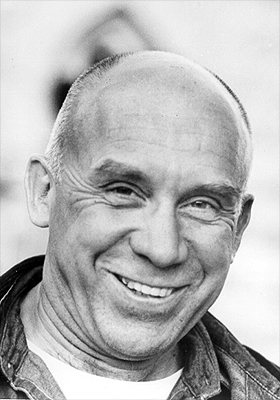
Birthday for Thomas Merton


Photo of Thomas Merton by John Lyons

Thomas Merton (January 31, 1915 - December 10, 1968)


How can I find Him who is everywhere? If He is everywhere, He is indeed close to me, and with me, and in me: perhaps He will turn out to be, in some mysterious way, my own self. But then, again, if He and I are one, then is there an "I" that can rejoice in having found Him?
                                                                                                                       - The Silent Life

My Lord God, I have no idea where I am going. I do not see the road ahead of me. I cannot know for certain where it will end. Nor do I really know myself, and the fact that I think I am following Your will does not mean that I am actually doing so. But I believe that the desire to please You does in fact please You. And I hope I have that desire in all that I am doing. I hope that I will never do anything apart form that desire. And I know that, if I do this, You will lead me by the right road, though I may know nothing about it. Therefore I will trust You always though I may seem to be lost and in the shadow of death. I will not fear, for You are ever with me, and You will never leave me to face my perils alone.
                                                                                                                       - Thoughts in Solitude


Thursday, January 24, 2013

forgiven much, loving more


But the one to whom little is forgiven, loves little.
                                                            Luke 7:47

Saint Augustine once said the God is always trying to give good things to us, but our hands are too full to receive them. If your hands are full, they are full of the things to which we are addicted. And not only our hands, but our hearts, minds, and attention are clogged with addiction. Our addictions fill up the spaces within us, spaces where grace might flow.
                                                            Gerald G. May, from Addiction & Grace

There is, within the heart of our being, a deep desire, a holy longing. It has been given many names by many people. It is a desire for fulfillment, for connection, for wholeness, for understanding, for meaning, for wakefulness, for salvation, for enlightenment, for love, for......

We are not always conscious or aware of this desire. Or, perhaps a better way of phrasing that would be to say that we are not always aware of its depth and breadth. Perhaps we get an inkling of it whenever we seek to satisfy it in the shallow waters of our living. We may seek fortune, notoriety, influence, professional success, or the security of relationships, only to find that in the end none of these fully satisfy, and some more than others fall woefully short. In our moments of disappointment or despair we may reach for other things to satisfy our holy longing:  entertainment, sexual pleasure, substances like alcohol or drugs to "take the edge off," eating, religious practices, or perhaps buckling down and filling up our hours with worthy work.

In these efforts we may come to find our deep desire misplaced, and attached--and perhaps fully addicted--to patterns and things and people that can never fully offer the satisfaction we long for.

Those who understand this best are those who have done the difficult, agonizing and honest work of recognizing their own attachments and addictions, and who have sought forgiveness. The recognition of our own attachments and addictions is humbling work, and it cannot be done alone. As any person in recovery will tell you, it cannot be accomplished as an individual act of will. We live in need of grace that transcends our own being. This is the heart of the gospel message, though sadly the Christian church has all too often turned faith and religion into another full smorgasbord of attachments and addictions which can also become barriers to our true desire and its greatest fulfillment.

It is said that once when Jesus was eating in the home of a Pharisee, a woman entered and began to anoint his feet. The host and Jesus' companions were troubled by this. After confronting his host's lack of hospitality, and affirming the way the woman has welcomed him, Jesus says, "Her sins, which were many, have been forgiven; hence she has shown great love. But the one to whom little is forgiven, loves little."

Our need for forgiveness is connected to our capacity to receive and offer love. That is a humbling message.

Until we are willing to walk the path--the lifelong journey--of recognizing and releasing our attachments and addictions, and welcome the forgiveness of our neighbor and of God, something within us remains closed. Love is not able to freely flow.

This is not the same thing as saying, "Woe is me, I'm such a lowly worm crawling through a giant dung heap!" It is instead a message of great hope and possibility. To gradually recognize and release attachments and addictions is to move closer and closer to the truth of our being in God, which means moving closer to the full satisfaction of our desires.

The moment we begin this path, the moment we even begin to express a desire to be on this path, we touch that holy longing within us, and love begins to make its way in, and out.


Thursday, January 17, 2013

Friday, January 11, 2013

koinonia


Shalom Mennonite Church
Sunday, January 6, 2013 -- Epiphany Sunday
Text:  Matthew 2:1-12
Eric Massanari

“koinonia”

I find it difficult sometimes
to move beyond a “manger mentality”
when I hear the stories of this season.

After years of hearing the stories told,
and seeing them reenacted in pageants
and portrayed in art and popular imagery,
it is hard not to feel like a distant observer,
a watcher standing apart from a drama
that unfolds in a distant time and foreign land.

3 kings in their silky raiments,
shepherds in their terry-cloth-towel turbans,
an open faced stable bathed in starlight,
Mary kneeling at a manger,
Joseph silently disappearing in the background,
and of course the special baby--
the extra-special-super-son-of-God-infant--
glowing with a light all his own.

It can be difficult to release these characters
from the caricatures they have become,
confined there in the manger,
waiting to be boxed up again until next year’s revival.

Perhaps more difficult than this
is to actually re-connect, re-join ourselves
to this story, and awaken to the truth that
this is not just about “them back then,”
it is a tale that is about “us right here.”

The coming of God through the Christ child
is God announcing not just one time but for all time:

I am.
I am with you.
I am as you are.
You are as I am.
We are one.

The coming of God through the Christ child
is an invitation of God to all people
to receive, to participate in 
the fullness of God’s own being.
to share in the depths of God’s own love.

There are few more powerful, tangible
ways to express such an invitation
to participate in the fullness of life
than a newly born human being.

To hold an infant is
feel in your arms the
beauty, fragility and resilience of life itself.
It is, in a sense, to find oneself
held by that living mystery
by which we all live
and move and have our being.

Alongside such a gift,
gold, fankincense, and myrrh 
are of no value or consequence.
By coming as a child,
God invites people to 
receive and share in this moment
with awe, wonder and great care.

Ysaye Maria Barnwell, a member of 
the women’s vocal ensemble,
Sweet Honey in the Rock,
wrote of this with these words:


For each child that’s born
a morning star rises
and sings to the universe
who we are.

We are our grandmothers’ prayers.
We are our grandfathers’ dreamings.
We are the breath of our ancestors.
We are the spirit of God.

We are
Mothers of courage
Fathers of time
Daughters of dust
Sons of great vision.

We are
Sisters of mercy
Brothers of love
Lovers of life and
the builders of nations.

We are
Seekers of truth
Keepers of faith
Makers of peace and
the wisdom of ages.

We are our grandmothers’ prayers.
We are our grandfathers’ dreamings.
We are the breath of our ancestors.
We are the spirit of God.
For each child that’s born
a morning star rises
and sings to the universe
who we are.
WE ARE ONE.
  • Ysaye M. Barnwell

I am, says God.
I am as you are.
You are as I am.
We are one.

Koinonia is the Greek word that
appears dozens of times in the New Testament
to describe this oneness we share 
with God and one another through Christ.
Koinonia means communion,
finding communion through
intimate participation in life together.

It was not just one child long ago
who deserved the homage of magi,
and shepherds, kings and slaves.
Each child is deserving of such homage.
Through each human life, as it emerges
and joins with the fullness of life in this world,
there is the invitation for full
participation in the life and love of God.

The magi who journeyed,
far from home, responding to dreams
and a deep call from a great mystery,
represent the invitation to all 
to become more than distant observers
or mere reactors to life,
but to share fully in the holiness of being.

And the magi, in their foreignness,
in their strangeness, and outsider-ness,
are a reminder that there are no limits
and no boundaries as to who may 
participate in and share this gift.

There are no limits and no boundaries
as to who may receive, participate in,
and share this gift of life in God.

And to share in it we must simply be,
with great love, who we are.  Amen.


Wednesday, January 2, 2013

the chalice of your life


Each day, the first day;
each day, a life.
Each day we must hold out
the chalice of our being to receive,
to carry, and to give back.
It must be held out empty...
                            - Dag Hammarskjold

For several weeks now this quote has stuck with me, with its image of our life being something like an empty chalice that we hold out each day. It seems a fitting quote as I begin to fill blank pages and lines in my fresh, new day timer. In fact, I made the decision to write this quotation just inside the cover of my schedule book. 

It isn't the first thing to get written on those pages, however. For several weeks now I've been filling in lines on the calendar with all sorts of events that have already been scheduled for 2013. The cusp of a new year is a rather arbitrary delineation, and the plow of life keeps forging ahead without pause!  Each entry on each date consists of a few words: a name, a place, a particular time. Nothing of much consequence at first glance, simply an appointment that has been scheduled and is meant to be kept.

However, each one is an encounter, full of possibilities! What will I bring to each one? A cup that is full-to-overflowing with my assumptions, prejudgments and agendas?  A cup with maybe a bit of room but mostly full of stuff I'm eager to pour out on those with whom I am committed to spending some time? Or, an empty cup, one with lots of room to receive and to also give what only God can provide?

This day is the second of January, the second day in the first month of a very new year. It is also the first day, and a life unto itself.

Author of All,
expand our hearts this day,
that your Word of Love may be 
written anew through our lives.
Amen

When even the shadows can heal

           Yet more than ever believers were added to the Lord, great numbers of both men and women, so that they even carried out the sick...