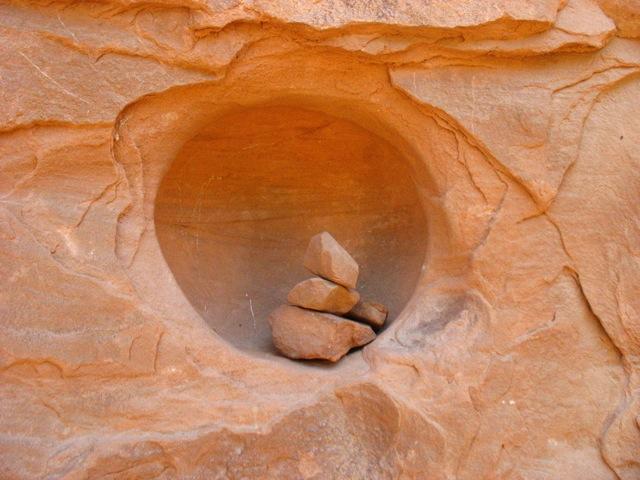
Wednesday, March 1, 2017

Befriending Silence


Silence is the pause in me

when I am near to God.

                         Arvo Pärt


Imagine a great symphony without spaces between the notes. Imagine a conversation with a beloved friend without pauses between the words. Imagine making your way through an incessant wall of noise without any distinction between voice or sound. It would be disorienting to say the least.


Silence is not just the absence of sound, it is a spacious and steady ground beneath all we say or do. All words we speak arise from silence, and return to it. All musical notes sung or played emerge from the silence and fall back to it. Silence is always there, waiting beneath the noise, the busyness and the excess of our daily living.


The 17th century mathematician and philosopher, Blaise Pascal, once made the observation, “All humanity’s miseries derive from not being able to sit in a quiet room alone.”


Perhaps there’s more than a little hyperbole in his statement, but there is much truth as well. We can grow accustomed to –even addicted to – the noisy distractions of our living. I hear in Pascal’s words the wise insight that we need silence in order to be well. We need enough silence and spaciousness in our lives to be able to reflect thoughtfully, to wait patiently, to listen attentively and respond wakefully to God’s presence within us and among us.


A more contemporary Christian teacher, Thomas Keating, puts it simply: “Silence is God’s primary language; everything else is poor translation.”  Are we listening? Are we open to slowing down, quieting down enough to befriend the silence that is always there within us and around us?


A Simple Silent Meditation Practice: Find a space where you know you will not be interrupted. Find a comfortable sitting position for your body, making sure your posture is upright and alert. Either close your eyes or let your gaze gently rest on the floor in front of you. Take several deep breaths, paying attention to your breath coming in and going out. Offer a quiet prayer of intention, welcoming God to meet you in this time. Sit in the silence. If you find your mind wandering or experience sleepiness, simply bring your attention back to the present moment by attending to your breath. Alternately, you might use a sacred word or name for God as your focal point. If you find yourself distracted simply offer this word/name in the silence as a renewal of your intention to be in this present moment with loving, non-judgmental awareness. Simply notice the thoughts as they arise and release them into God’s care. Our minds are active and there is a reason why many wise teachers have described our chronic thought patterns as “monkey mind”! At the end of the time quietly offer a prayer of gratitude. Trust that this time is a precious gift that will go with you into your day. If this sort of practice is unfamiliar you might start with just a few minutes of silence and then increase the time to a 20-30 minute meditation period.


Originally published in Kidron Bethel Village's Village Voice newsletter (March 2017)

Wednesday, February 8, 2017

The House of Mirrors


The House of Mirrors

Here in the house of mirrors there
are many choice vantage points for
gazing on yourself
gazing on yourself

gazing on
your
self.

If you are fortunate enough
to stumble across a window
in this place of figments
do not fear the strange view

climb
through
it.

Alternately, a hammer
may prove useful here—
that is, if you really
want to see

your
true
face.

Monday, January 23, 2017

Wounded Sight


Honey Locust at Heartland Farm, November 2014


I will soon receive one of the quintessential signs of growing older: bifocals—well, “progressive lenses,” to use the more exact term. I'm not sure a hipper sounding name will make them any more welcome on the bridge of my nose. Though I wore eyeglasses throughout my childhood, I've managed to do without them through most of my adult years. Now, the passage of time has caught up with me and my eyes are letting me know that they require some assistance.

As I sat through my eye exam last week I marveled at the mechanics of sight. Vision is no small miracle; it is, in fact, the result of a whole chain of miracles. There is the strange miracle of light, behaving as both wave and particle, there is the evolutionary miracle of the eye itself, and its linkage through a nerve-cable to our brain—our miraculous, wondrous brain!—which flips the images we see right-side-up and helps us process, remember and make meaning of what we see. 

Sight is also connected to our heart. I do not mean merely the heart that pumps away at the center of our chest, but the very heart of our being, that living center of existence where our body, mind and spirit are woven together as one. This is the heart spoken of in scripture, such as the refrain found throughout the psalms: “I will praise you, O Lord, with my whole heart.”

What we see is connected to this heart of our being. If we are willing to look on our world and our life with open eyes, our hearts will inevitably be wounded by what we see. To possess vision is to be wounded.

I remember seeing, for the first time, a homeless person sleeping on the streets. I remember seeing my parents and family members weeping at my young cousin's funeral. I remember seeing death for the first time. I remember more than one occasion on which I saw the painful results of my ill-spoken words and my hurtful actions. These were wounding sights. One cannot un-see such things. Once seen, they become part of us, wounds deep within. Such wounds, if we do not deny or ignore them, have the potential of awakening greater compassion, wisdom and insight. 

Our sight is wounding because sometimes it is wounding to be seen. It is said that “the eyes are windows to the soul,” and it is not always a comforting thing when someone looks into our eyes, our soul, and sees something we might rather hide from view. There is a wound that comes when we know ourselves as fully seen by our neighbor and by God, and grow more vulnerable and humble in their sight. Once again, this is the sort of wounding of the heart that can soften us, deepen us and open us.

If you have been given the gift of sight, give thanks for it this day. It is precious, and not to be taken for granted. Gaze on your life and the world with curiosity and wonder. Remain open to both the beauty and the brokenness that you see. Have the courage to let yourself be seen as you meet the gaze of beloved ones in your life, and as you live in the loving sight of God. In this way may our hearts continue to expand and open with love.

Wednesday, November 30, 2016

Advent Week 1: Into wilderness


See, I am sending my messenger 
before your face,
who will prepare your way;
the voice of one
crying in the wilderness . . . 

MARK 1:2-3  


Perhaps it was only in the wilderness of the Jordan River that John the Baptist's message could be heard and understood. People had to leave behind the comforts of home, the noise of daily living and their carefully oiled mechanisms for control. They needed to walk out into a place that had a reputation for being dangerous and unnerving for its utter unfamiliarity and emptying silence. They had to accept such exposure before they could fully turn toward a life they had never known or expected.

Perhaps it is only in the wilderness that we hear and understand some new thing, a new birth that is waiting but cannot yet be perceived. The wilderness of not knowing, not seeing, not controlling is present, sometimes at the margins of our living and sometimes it seems to be everywhere we look. Always it invites us to willingly traverse its reaches and prepare to turn, and turn yet again.


Sunday, November 27, 2016

First Sunday of Advent 2016


Deo gratias

For early morning when darkness
is slow to leave, and a candle flame
reveals the persistence of light,


Deo gratias,
thanks be to God.


For the maple tree’s feisty root
pushing up through my sidewalk,
and all the messy forcefulness of life,


Deo gratias,
thanks be to God.


For the losses we must bear
and the friends who will not let us
carry the burden of grief alone,


Deo gratias,
thanks be to God.


For the one I want to name “my enemy”
and the mirror he may be to my own
unholy words, my own shameful actions,


Deo gratias,
thanks be to God.


For the injury, the illness, the wound,
and what these might teach us about
receiving a neighbor’s love,


Deo gratias,
thanks be to God.


For disappointed hopes and unfulfilled
dreams, and the doorways they
become to new possibilities,

 
Deo gratias,
thanks be to God.


For the eventide of this day and of this life,
when the Mystery of all mysteries grows near
and life glows most precious and full,


Deo gratias,
thanks be to God.


For this moment—
for this uncommon moment—
and for our common life,


Deo gratias,
thanks be to God.


Friday, February 27, 2015

friends


                                                                                                                                                     ©Yolanda Kauffman     


This is my commandment, that you love one another as I have loved you. No one has greater love than this, to lay down one’s life for one’s friends. You are my friends… JOHN 15:12-15

But what happiness, what security, what joy to have someone to whom you dare to speak on terms of equality as to another self; one to whom you need have no fear to confess your failings; one to whom you can unblushingly make known what progress you have made in the spiritual life; one to whom you can entrust all the secrets of your heart and before whom you can place all your plans! 
                      Aelred of Rievaulx, Spiritual Friendship (12th cent.)

I’ve got your back,” a friend said to me recently. The message I received in that moment was: “If you fall, I’ll be here to help you. If you fail, I will stand beside you. If you get hurt, I will help you heal. If you need a hand, I’ve got two.” It was a simple statement of steadfast loyalty and love—the love of a true friend.

Jesus goes even farther in his message on friendship: a friend is willing to lay down life for the sake of the other. He said this, and soon thereafter he lived out the meaning of these words for all to see; he offered his own life out of love for his friends.

I’ve never been asked to go so far in a relationship. I’ve never faced a moment in which I was asked to literally sacrifice my life for the sake of a loved one. What would any of us do in such a moment? 
 
I wonder if we can even contemplate sacrificing our life for another if we haven’t already been practicing “laying down life” in the ordinary, daily moments when we are asked to make much smaller—but far from insignificant—sacrifices for our friends, neighbors, and even strangers. Have I been willing to “lay down” resentments, jealousies, prideful self-seeking, irritations big and small, my “to do” lists, among other things, for the love of my friends and neighbors? 
 
             Friendship is an invaluable gift. If you’ve heard a friend speak the words “I love you,” then you have grown wealthy beyond measure in this life. If you’ve had a friend show you that love in action, then there really is no greater treasure you could hope to receive.

             Give thanks for the holy ground of the friendships in your life. How might you express that gratitude today? Where are you being invited to “lay down life” for the love of your friends?

Tuesday, December 30, 2014

new year's intentions


                                                                                                                           photo:  feather  by Yolanda Kauffman


The threshold of a New Year naturally invites reflection and anticipation. We reflect on the swift passing of one year with its varied layers, and we anticipate all that is yet to come.

In the past I've joined many people, and perhaps you, too, in making New Year’s resolutions. Sometimes the resolutions were practical: “I will get physical exercise at least four times each week.” In other years, they were more introspective and intangible: “I will be more patient with interruptions, more open to spontaneous opportunities.”

It's one thing to make a resolution, and it's another thing entirely to follow through on it! Only rarely has my follow-through lasted an entire year. More often than not, if you met up with me in July and asked how my resolutions were going I would've been hard pressed to even remember them clearly.

I've observed over time that my resolutions often contain a degree of judgment directed toward myself or the world around me. Resolutions typically include an assumption that what is, right now, is not okay; it is lacking in some way. Therefore, I must work to change it (my fitness level, my impatience, etc.).  This means I approach a resolution as an act of will. It is up to me to buckle down and see it through. If I don’t then I've failed in some way, and I have only myself to blame.

The root of the word resolution literally means “reducing things to simpler forms.” It has also grown to mean finding the answers, or “taking the bull by the horns.” It means I often reduce my world down to me.

There is a place and time in this life for such individual resolve. However, I've found that the most creative changes in life have not come through my own willful resolutions or my efforts to take control. The most meaningful transformation has come more in the moments that required me to release my grip, to let go of my own willfulness, and to live from a place of openness, vulnerability, and deeper trust.

True and lasting change in this life comes when we are willing to start right where we are,   without first wishing life to be any different than it actually is. This is where Love meets us. Love has the power to work only through what is true and real. So, on the cusp of this New Year, with all that has been and all that yet may be, may we be right here, right now, with one another, and with the Great Love that has the power to transform all things.   


Friday, November 21, 2014

soak up sun like stone


Cold autumn day, yet
to be still is to grow warm -- 
soak up sun like stone.


photo: center stone at Heartland Farm labyrinth


Monday, October 20, 2014

Born of Spirit: A Song of Nicodemus


Born of Spirit: A Song of Nicodemus

for Nathan at the celebration of your ordination

The wind blows where it chooses,

and you hear the sound of it,

but you do not know where it comes from

or where it goes.

So it is with everyone

who is born of the Spirit.

JOHN 3:8


See the scrolls and volumes on the shelf,

reams of pages written,

countless sermons spoken (many forgotten)—

words upon words

within words.


Know that all speech of the Beloved

remains one step (or more)

removed from the Source.

All of our descriptions are stammerings.


We speak our holy names,

and utter precise explanations.

Some are exquisite and beautiful,

some seem quite reasonable,

and altogether possible.


Our utterances are stones, piled into cairns,

marking a path through wilderness.

They show us the way,

we hope.


Sometimes they are joined

with the mortar of fear and time

and they become a shrine,

a sanctuary,

a fortress.


“Lord, it is good for us to be in this place!”


Only, we discover that to remain in this place

is to lose our Way.

We must go back down the mountain.


We are called to wander from the well-lit path,

away from roads of exposition,

into the wild lands of encounter.


So leave the books to collect their dust,

leave the parchment bare,

trust that the silence will not fail you.

Know that “blessed are the beginners”

and so are all who listen for wind,

and wonder in the dark.


Here you will know Jacob's struggle,

and blessing,

and wound.


Here you will know Mary's joy,

and surrender,

and lament.


Here you will dwell in the Teacher's questions:


      “What are you looking for?”


      “Who do you say that I am?”


      “Are you willing to drink the cup that I drink?”


Do not rush you response.

Live fully your momentary answers,

and live the possibilities together

with your sisters and your brothers.

Listen for the Great Wind that blows where it chooses.


Let it pass through you,

that you might be born of it again,

and yet again. 

Saturday, August 2, 2014

exposure


Displaying photo.JPG
 
Birdbath after rainstorm” ©Eric Massanari

Light is a powerful and life-sustaining presence in our lives. We depend upon it, especially the light of the Sun around which we turn each day and night. Without this great light, life would cease on Earth.

I remember my first visit to the Grand Canyon years ago, walking out onto the South Rim and feeling my breath catch for a moment as my eyes, mind, and heart tried to take in the play of sunlight on the incomprehensible expanse of it all. The Native Americans who once made this their home referred to it as The House of Stone and Light.

On that same trip we stopped in Las Vegas, Nevada. As we walked down the Las Vegas Strip I was overwhelmed by the rainbow hues of neon, casting colorful light on the faces of people, and reflecting off the tinted windows of casinos. I couldn’t feel this light. It had no endurance, no vitality to it. That strange city is a house of a very different kind of stone, a wholly different kind of light, and it felt terribly life-less.

Across spiritual traditions Light is used as a metaphor to describe experiences of awakening, deepening awareness, and expanding insight. We use terms like enlightenment, and illumination. It is associated with the revelation of Divine truth and presence. In my own Christian tradition, light becomes a primary metaphor for God’s gift to the world in Jesus. In the words of Zechariah, father of John the Baptist:

By the tender mercy of our God,
a dawn from on high will break upon us,
to give light to those who sit in darkness and in the shadow of death,
to guide our feet into the way of peace.
Luke 1:78-79

The Light that guides us to our true selves and “on the way of peace” is revealed in so many ways. Sometimes it shows itself in blinding, revelatory flashes of insight and understanding rising from within, and sometimes it reveals itself only in dim glimmers of possibility and hope amidst the darkness. Sometimes, it even appears as darkness to our eyes that have been blinded by the life-less lights of our own creation.

The Light dwells in all people, glows through any moment, and streams through the many traditions of faith and spirit that have illumined the souls of women and men through millennia and summoned people to gather and know their shimmering unity.

As you go about your day, look for signs of the Light shining in the world around you and through the people you meet. Trust that this will be revealed to you. And as you live, trust also that you bear this Light in your own being - it is your own nature - and you have been given this to share freely with the world.

What we plant in the soil of contemplation
we will reap in the harvest of action.
Meister Eckhart

Friday, July 25, 2014

living the open questions


                                      “Canyonlands cairn” ©Yolanda Kauffman


The next day John again was standing with two of his disciples, and as he watched Jesus walk by, he exclaimed, "Look, here is the Lamb of God!" The two disciples heard him say this, and they followed Jesus. When Jesus turned and saw them following, he said to them, "What are you looking for?"   John 1:35-38
 
You might take a moment to imagine yourself walking that road behind Jesus, having just left one teacher and now wondering how to approach this potential new teacher. Before you can figure out what to say to him he turns, sees you following, and asks you directly: “What are you looking for?”  How would you answer?
Throughout the gospel accounts we find Jesus teaching people by asking questions. Not just any sort of questions, of course. It is entirely possible for us to ask what I would call closed questions that essentially amount to answers and statements of presumption:  What is your problem?  Didn’t you realize that was going to happen? Don’t you hate it when….?  Don’t you just love it when….?  Isn’t this a beautiful day?
Jesus, like so many great teachers, knew the power of living with open questions, questions that invite living our way into life with an open heart and an open mind:  What are you looking for? Do you want to be made well?  Who do you say that I am?  Can you drink from the cup that I will drink?
These are the questions that invite the disciple to listen within for the presence and guidance of God’s Spirit. Often times these are the sorts of questions we will need to return to again and again in the course of our lives:  Who am I? What is my deepest desire? Where do I see God at work in my life?
Sometimes the open questions are the ones that lead us deeper into relationship with our sister and brother:  Who is my neighbor? What does this person have to teach me? How is God already at work in your life?
If we live only with our iron-clad answers and well-defended assumptions it is difficult for us to hear the voice of God and to keep growing. When we allow the most intimate and open questions of faith to lead us then we know we are on a holy and vital path of life in God. As the poet Ranier Maria Rilke once advised an eager and aspiring young poet:
Be patient toward all that is unsolved in your heart and try to love the questions themselves, like locked rooms and like books that are now written in a very foreign tongue. Do not now seek the answers, which cannot be given you because you would not be able to live them. And the point is, to live everything. Live the questions now. Perhaps you will then gradually, without noticing it, live along some distant day into the answer.   - from “Letters to a Young Poet”

When even the shadows can heal

           Yet more than ever believers were added to the Lord, great numbers of both men and women, so that they even carried out the sick...